BlackHole Simulator
A downloadable game for Windows and Linux
Black Hole Simulator
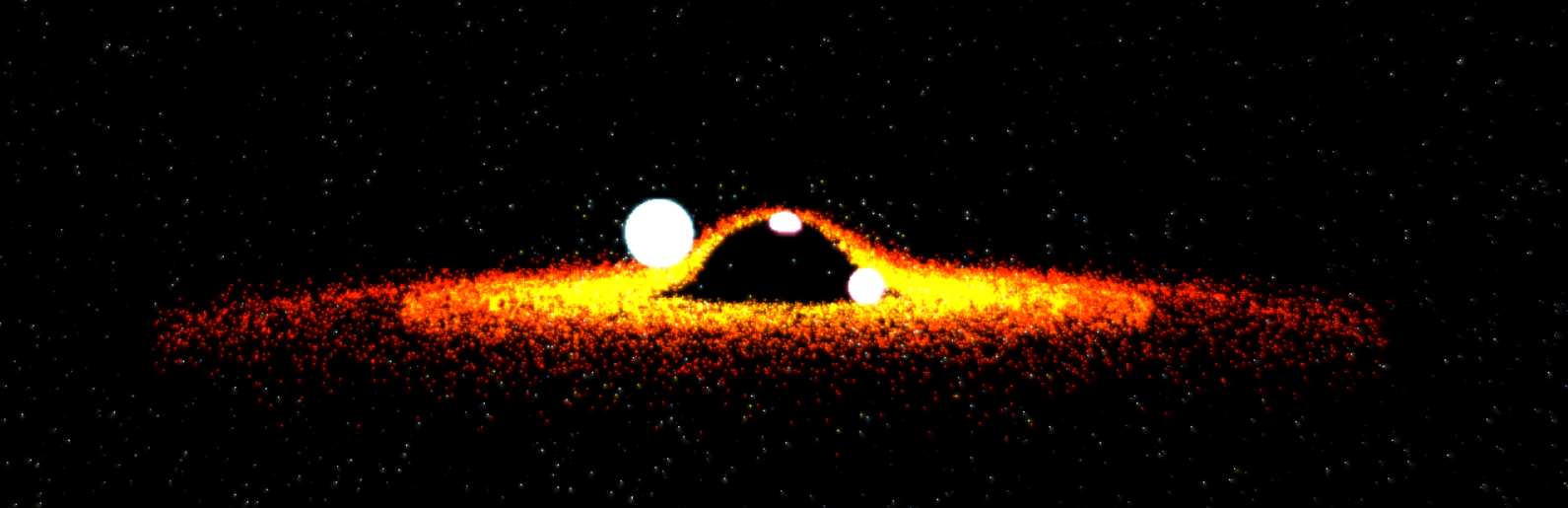
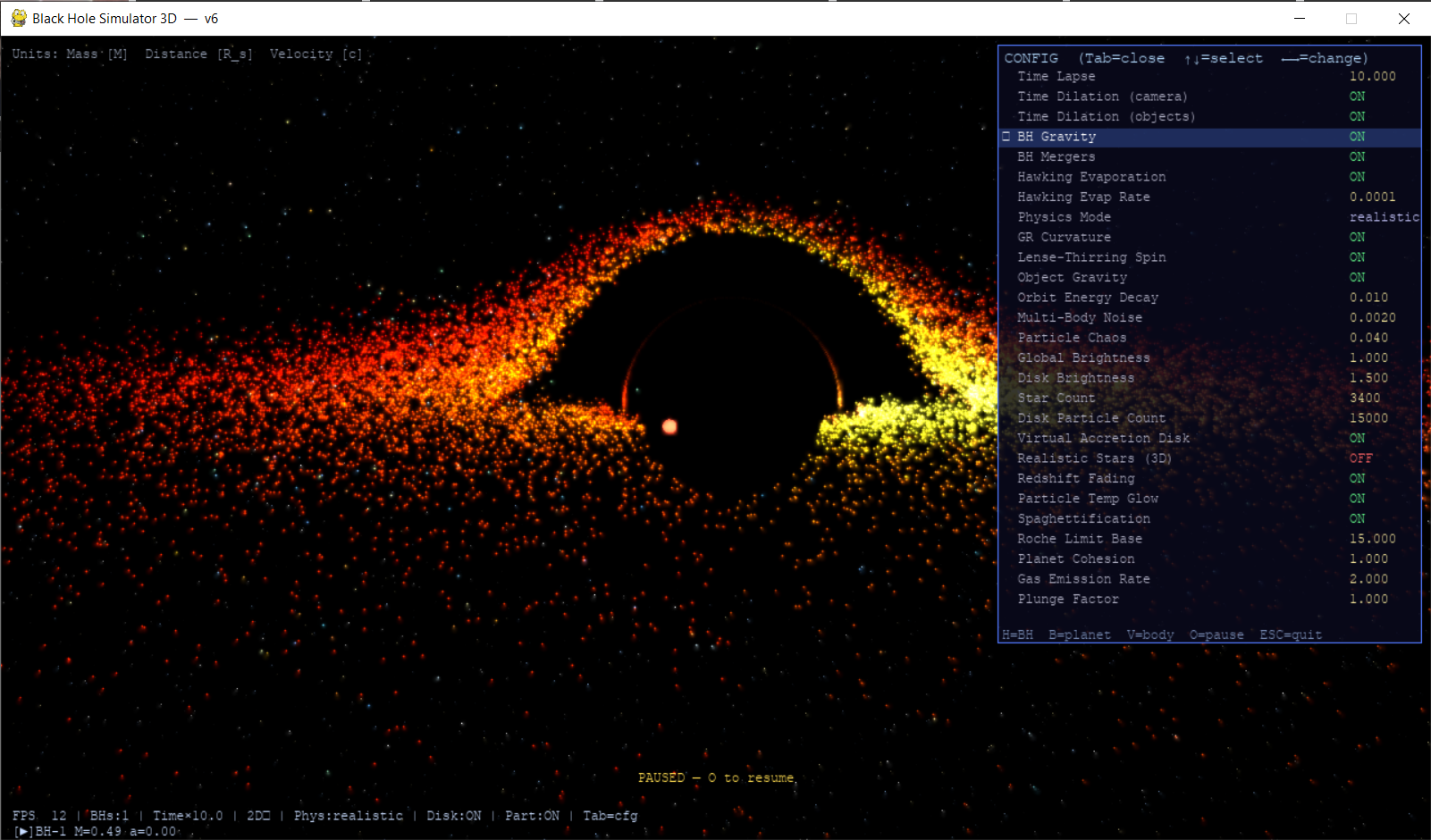
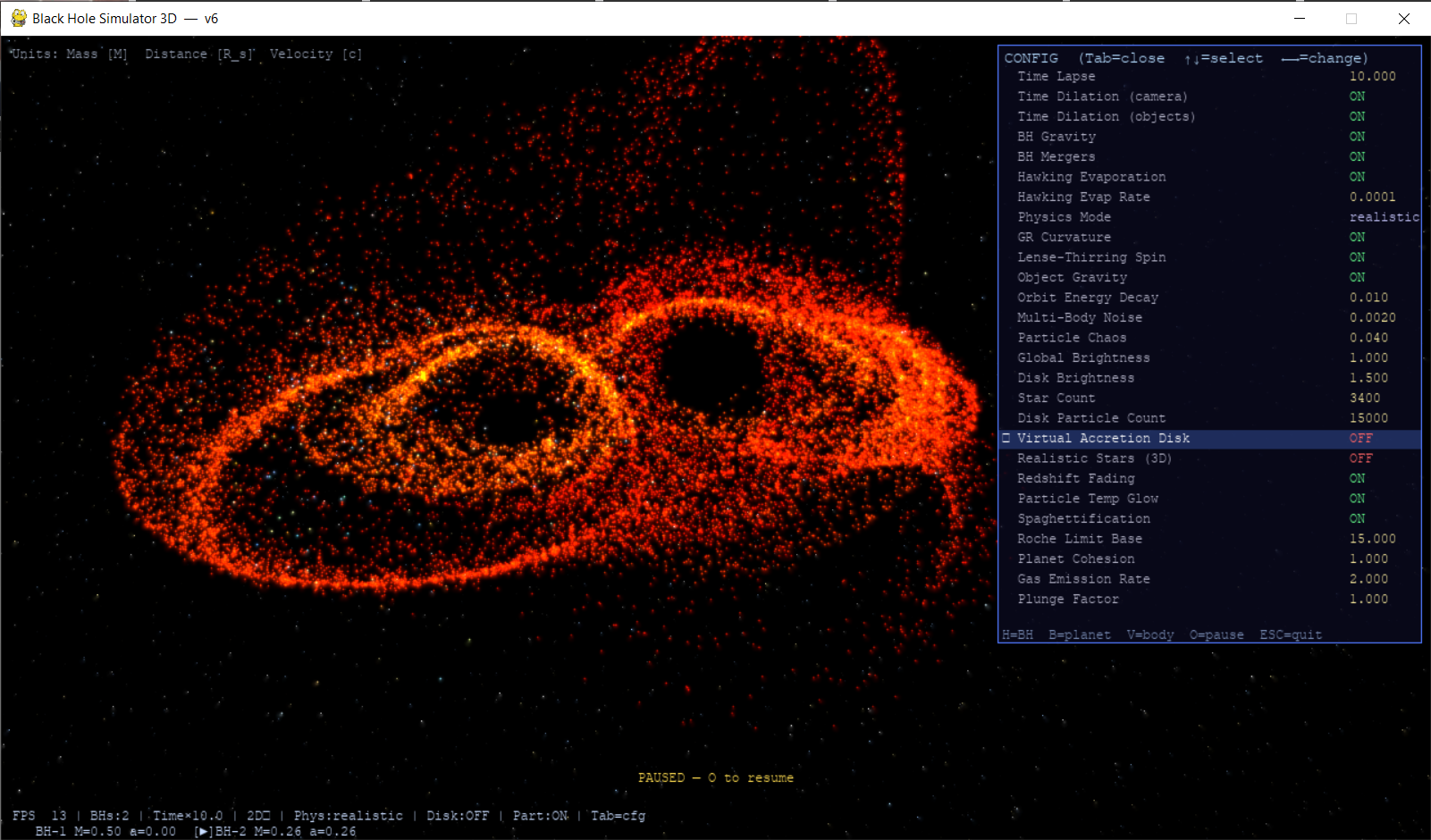
A real-time 3D black hole physics simulator , featuring gravitational lensing, accretion disk dynamics, N-body black hole interactions, and tidal disruption events. You can explore the open-source repository on GitHub.
Features
Black Holes
- Multiple black holes with independent mass, spin (Kerr parameter a), position and velocity
- N-body gravitational interaction using the Paczyński–Wiita pseudo-Newtonian potential
- Black hole mergers — momentum conserved, ~5% mass-energy radiated as gravitational waves (Christodoulou formula), spin approximated from angular momentum
- Hawking evaporation — mass loss rate ∝ 1/M²
- Kerr event horizon radius: r₊ = GM + √(G²M² − a²)
- Photon sphere, ISCO (prograde Kerr), shadow radius all derived per-BH
Accretion Disk
- Keplerian thin disk with temperature profile T ∝ (r/r_ISCO)^−3/4 (Novikov–Thorne)
- Doppler shift — blueshift approaching side, redshift receding side
- Gravitational redshift — colors fade toward infrared near the horizon
- Lense–Thirring precession (frame dragging) for spinning black holes
- Photon ring reconstructed from disk particle angular distribution
Planet & Body Simulation
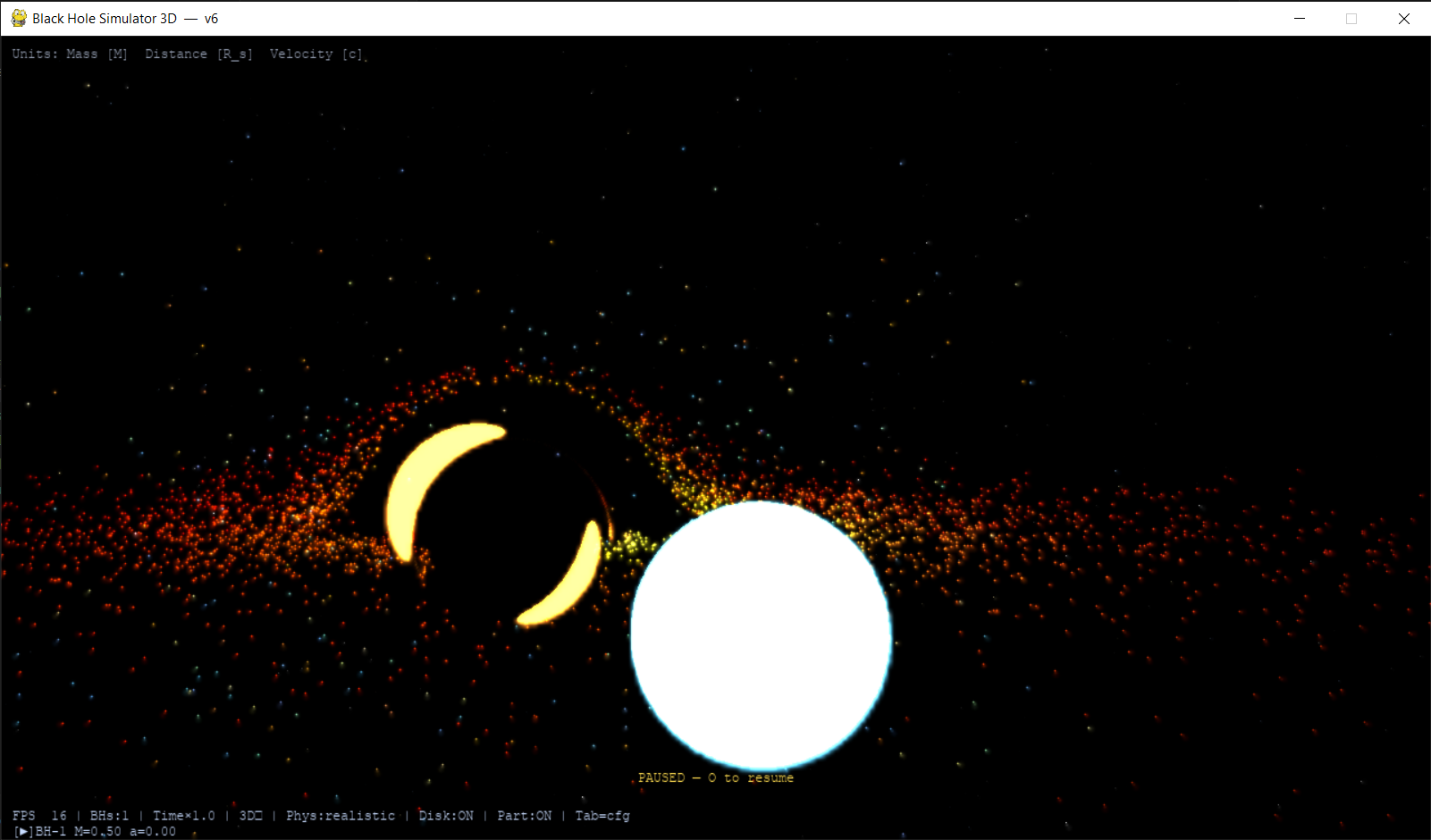
- GasPlanet: tidal spaghettification, Roche limit disruption, comet-tail debris stream
- CelestialBody: hard rocky object, gravitational infall, EH fade
- Time dilation for objects near the horizon (Schwarzschild factor)
- Objects accrete into the BH on crossing the event horizon
Particles
- Free particle system with RK4 integration under multi-BH gravity
- PARTICLE_FORCE: optional weak inter-particle gravity (self-gravity, O(N²) branchless)
- PARTICLE_AUTO_ZOOM: perspective-correct particle size (size ∝ 1/depth)
- Thermal glow — velocity-dependent color shift toward blue-white
- Absorbed by BH when crossing rs, released when disk is disabled
Stars & Lensing
- Realistic 3D star sphere (80 000 px radius) — stars fixed in world space, rotate with camera
- Gravitational lensing of stars and particles using thin-lens deflection angle: δφ = 4GM / (rc²)
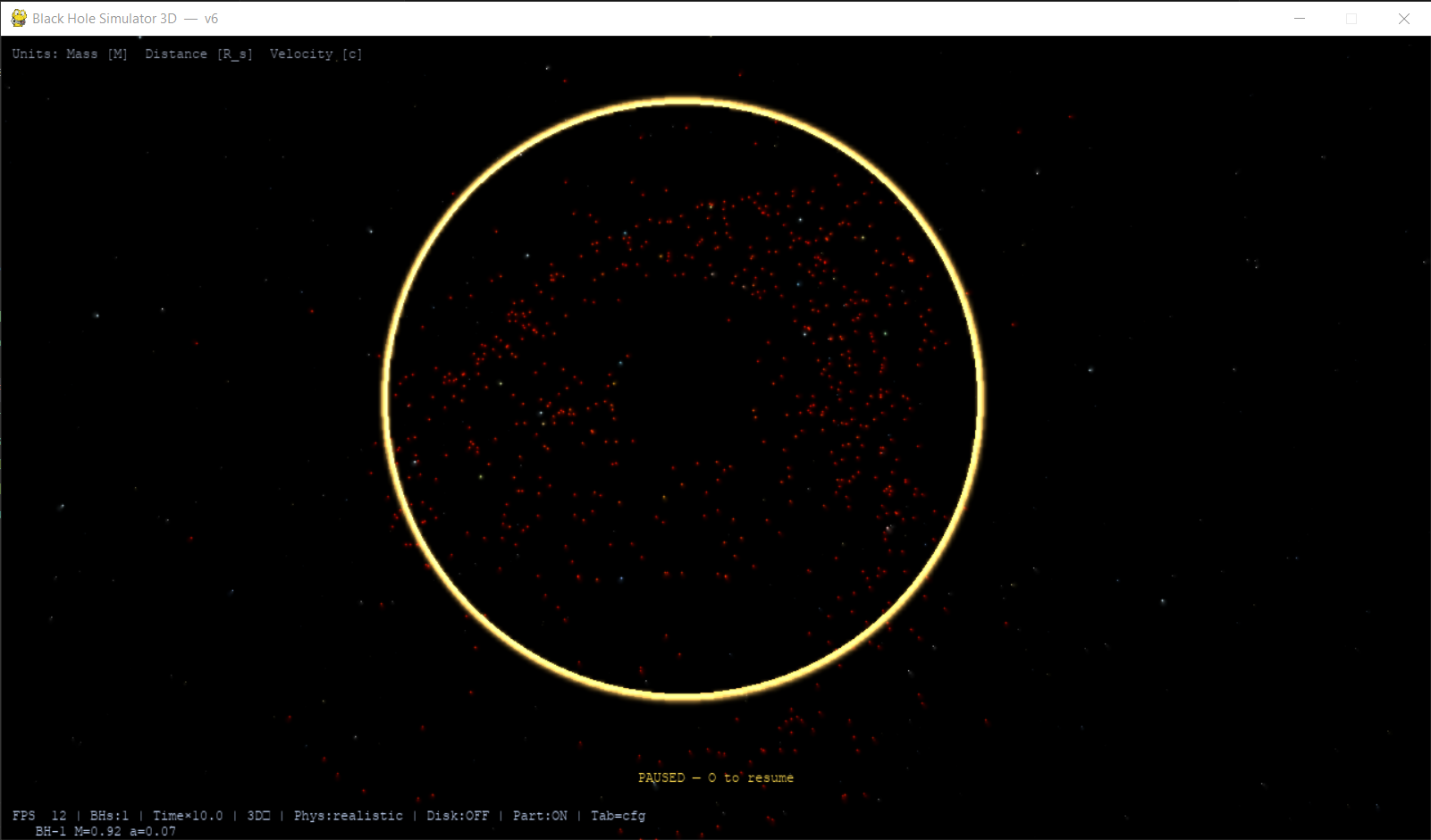
- Einstein ring formation when source, BH, and observer are aligned
Camera
- Free-fly 3D camera with perspective projection
- Mouse drag rotate, WASD move, Space/Ctrl up/down
- Time dilation on camera — sim slows down as camera approaches horizon
Controls
Camera
| Key | Action |
|---|---|
| Mouse drag | Rotate |
| W / A / S / D | Move forward / left / back / right |
| Space / LCtrl | Move up / down |
| LShift | Speed ×3 |
| Arrow keys | Rotate camera |
Black Holes
| Key | Action |
|---|---|
| H | Spawn BH in front of camera |
[ / ] | Cycle selected BH |
| M / N | Mass ±0.05 M_geo |
| K / J | Spin ±0.05 |
Objects
| Key | Action |
|---|---|
| B | Spawn GasPlanet |
| V | Spawn CelestialBody |
Toggles
| Key | Action |
|---|---|
| Tab | Open / close config panel |
| O | Pause / Resume |
| Z / X | Time lapse ±0.5× |
| P | Physics mode: realistic ↔ 2-body |
| T | Camera time dilation ON/OFF |
| E | Hawking evaporation ON/OFF |
| G | BH gravity ON/OFF |
| F | BH mergers ON/OFF |
| Y | Virtual accretion disk ON/OFF |
| C | Free particles visible ON/OFF |
| R | Redshift fading ON/OFF |
| I | Particle temperature glow ON/OFF |
| U | Spaghettification ON/OFF |
| S | Realistic 3D stars ON/OFF |
| ESC / Q | Quit |
Config Panel (Tab)
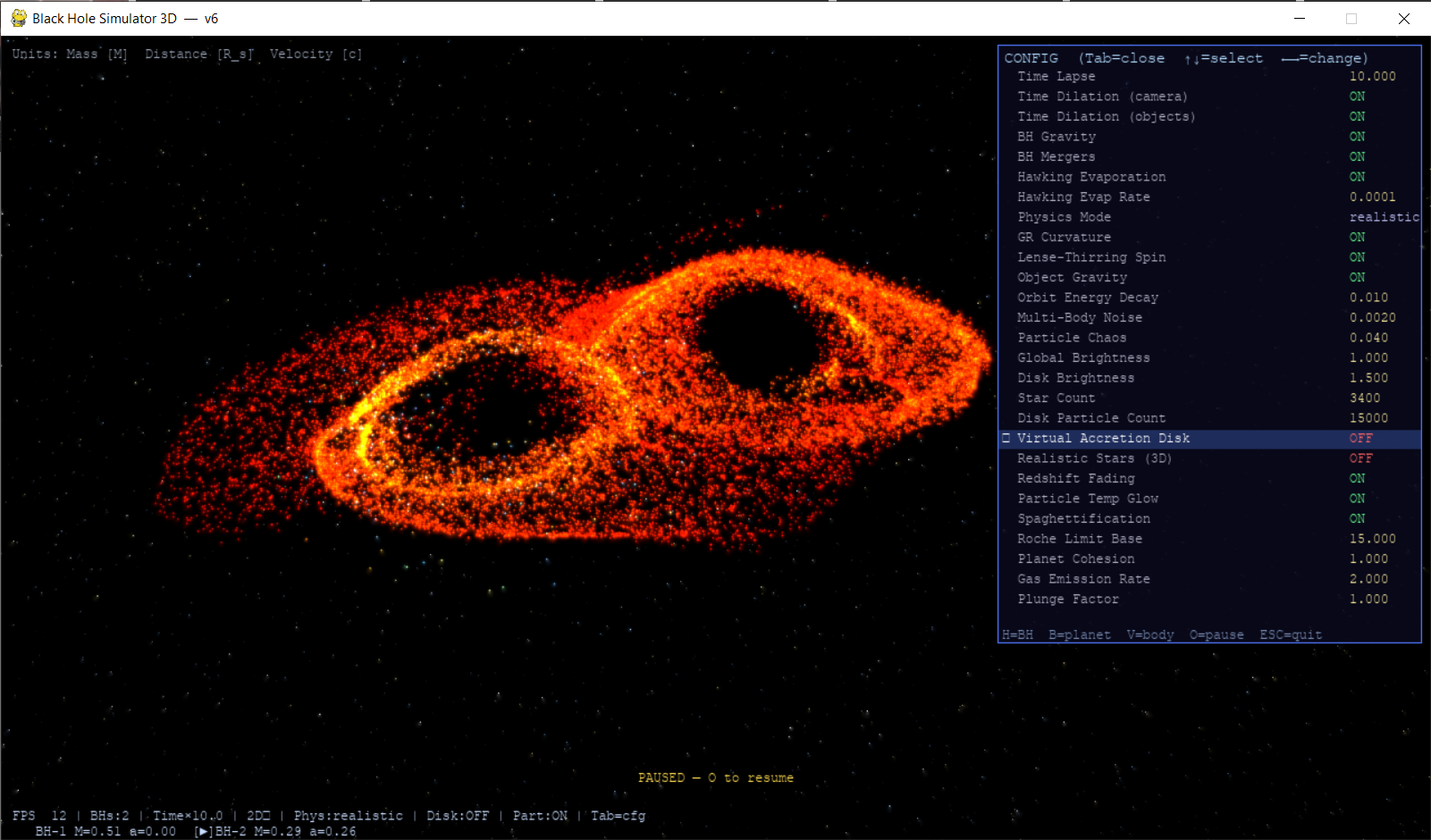
Navigate with ↑↓, adjust value with ← →.
Physics & Algorithms
Spacetime & Gravity
- Kerr metric — event horizon, ISCO, photon sphere computed analytically
- Paczyński–Wiita potential — pseudo-Newtonian approximation for N-body BH interactions: V(r) = −GM / (r − r_s)
- Schwarzschild gravitational redshift: z = 1 / √(1 − r_s/r)
- Geodesic integration — RK4 on the Schwarzschild effective potential for disk particles
Gravitational Lensing
- Thin-lens approximation: θ± = (β ± √(β² + 4θ_E²)) / 2
- Einstein radius: θ_E = √(4GM · D_LS / (c² · D_OS · D_OL))
- Applied to stars, particles, and celestial bodies; produces Einstein rings and double images
Orbital Mechanics
- Keplerian angular velocity: ω = √(GM) · r^−3/2
- Lense–Thirring frame dragging: Δω = 2GM·a / r³
- Novikov–Thorne disk temperature: T ∝ r^−3/4 · (1 − √(r_ISCO/r))^1/4
Mergers
- Christodoulou formula approximation: M_final = (M₁+M₂) · (1 − 0.0523η), η = M₁M₂/(M₁+M₂)²
- Spin from angular momentum: a_final ≈ (L_1 + L_2 + L_orb) / M_final²
Spaghettification
- Roche limit tidal disruption: intensity = 1 − r/r_Roche
- Shrink rate ∝ intensity², debris stream inherits orbital tangential velocity (TDE debris stream model)
Thank you for using my project! If you enjoy exploring this simulation, please consider leaving a rating or supporting my work.
Connect & Support:
- Follow my development logs on YouTube
- Check out the source code on GitHub
- Connect with me on Facebook
If you encounter any issues or bugs, please leave a comment on this game page. Enjoy the spacetime simulation! ',:)
Download
Click download now to get access to the following files:
Leave a comment
Log in with itch.io to leave a comment.